Tihar: When Nepal Lights Up with a Thousand Lights
Five days of celebrations, traditions, sacred animals, and small rituals that reveal a side of Nepal far deeper than anything you’ll find along the usual tourist routes.
There are moments when Nepal still manages to surprise me. And I’m not talking about the towering Himalayan mountains, the rushing rivers, or the landscapes I continue to explore during my expeditions. I’m talking about everyday life, the people, and the traditions that have stood the test of time, turning even a simple walk through the streets of Kathmandu into something special.
One of those moments is Tihar, the Festival of Lights, one of Nepal’s most beautiful and cherished celebrations.
For five days, the entire country takes on a different character. Homes glow with lights, doorways are decorated with colorful flowers, and the streets come alive with music and singing. But beneath this festive atmosphere lies something much deeper: a blend of spirituality, respect for animals, family bonds, and ancient beliefs.
That’s exactly what fascinates me about Nepal. Here, spirituality isn’t necessarily something separate from everyday life. You find it in the streets, in small gestures, in offerings placed outside a doorway, or in a flower garland draped around a dog’s neck.
What Is Tihar?
Tihar is a traditional Nepalese Hindu festival usually celebrated between October and November, during the month of Kartik in the local calendar.
Also known as Deepawali, the Festival of Lights, it lasts five days, each dedicated to a particular celebration.
Two deities play especially important roles in the festival: Laxmi, the goddess of prosperity and abundance, and Yama, the god of death.
It might seem like an unusual combination, but that’s one of the most fascinating aspects of Tihar: celebrating life also means acknowledging its fragility, respecting living beings, and remembering the importance of the relationships that connect us.
Alongside the deities, crows, dogs, cows, and oxen are also honored. These animals hold profound symbolic meaning in Nepalese culture.
Day One: Kag Tihar, the Festival of Crows
Tihar begins with a celebration that might seem rather unusual to those of us from the West: a day dedicated to crows.
In Hindu tradition, crows are associated with Yama and are believed to be messengers from the world of the dead.
During Kag Tihar, families leave food for them, often on rooftops or in courtyards, as a gesture of respect and a symbolic way of warding off bad news and misfortune.
Crows are a constant presence in Nepalese cities. You hear them calling from the early morning hours and see them practically everywhere.
During Tihar, however, even these common birds become the focus of a ritual rooted in ancient beliefs.
Day Two: Kukur Tihar, When Dogs Take Center Stage
If there’s one day of Tihar that immediately captures the hearts of Western visitors, it’s probably this one.
Kukur Tihar is entirely dedicated to dogs.
In Hindu mythology, dogs are associated with Yama, the god of death, and are considered guardians and companions of souls on their journey to the afterlife.
For one day, they receive some very special attention.
They’re adorned with flower garlands, a colorful blessing mark called tika is applied to their foreheads, and they’re offered food.
What I find particularly meaningful is that this tradition isn’t limited to family pets. It also includes dogs that live on the streets.
And anyone who knows Kathmandu knows just how many stray dogs there are!
Seeing a stray dog wearing a garland of bright orange marigolds around its neck is one of those images that tells you more about Nepal than words ever could.
Beyond its religious significance, I like to think of this day as a small but powerful lesson: even the animals we often overlook have an important place in our world.
Day Three: Sacred Cows and the Night of Laxmi
The third day is one of the highlights of the festival.
The morning is dedicated to Gai Puja, the worship of cows.
In Nepal, the cow is the national animal and is considered sacred in Hindu tradition. It symbolizes motherhood, generosity, nourishment, and abundance.
During the ceremony, cows are blessed, decorated with flowers and tika, and given offerings of food.
For travelers exploring Nepal, especially beyond the main tourist areas, these celebrations offer a glimpse into a rural world where animals, religion, and family life remain deeply interconnected.
But it’s when evening arrives that Tihar reveals its most spectacular side.
Laxmi Puja: A Night Illuminated by Thousands of Tiny Lights
The evening of the third day is dedicated to Laxmi, the goddess of prosperity.
According to tradition, the goddess visits people’s homes that night, bringing good fortune and well-being.
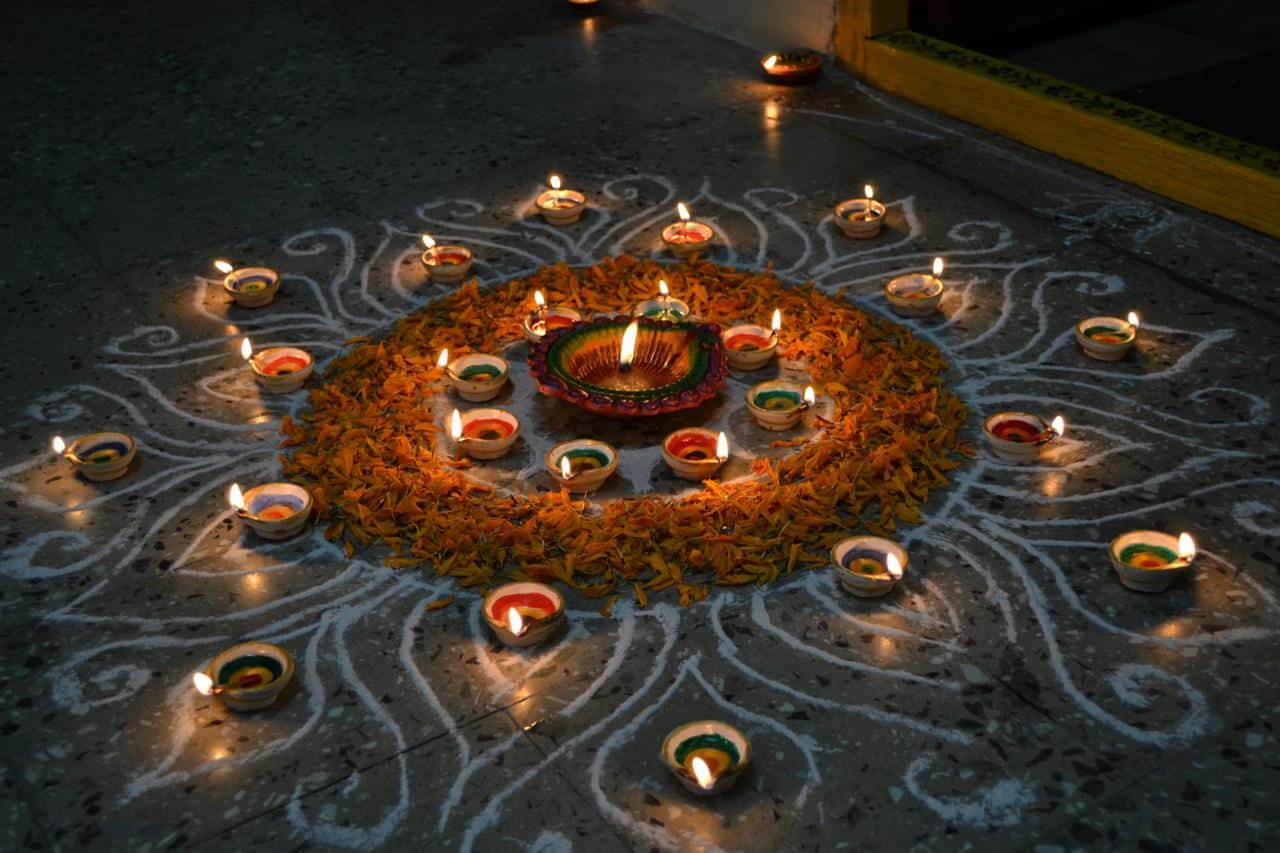
To welcome her, families carefully clean their homes and decorate entrances, windows, and courtyards with oil lamps, candles, and strings of lights.
Outside doorways, you’ll see rangoli, intricate designs created with colored powders, flower petals, and other materials. In many homes, small symbolic footprints are also drawn to guide the goddess inside.
It’s a time when Kathmandu takes on an entirely different atmosphere.
Lights illuminate balconies, windows, small temples, and courtyards. Incense burns outside homes, while prayers and music can be heard almost everywhere.
There’s something truly captivating about it all.
You don’t need grand monuments or elaborate ceremonies. Sometimes all it takes is stopping along a narrow street, watching a family prepare its offerings, and letting yourself become part of the atmosphere.
Deusi and Bhailo: Songs, Dancing, and Open Doors
Another distinctive Tihar tradition is Deusi and Bhailo.
Groups of children, teenagers, and sometimes adults go from house to house, singing and dancing.
Families welcome them with sweets, food, or small amounts of money.
It’s more than just entertainment. These songs are considered blessings and are a way of wishing prosperity and happiness to the people living in each home.
The streets become places of connection, music, and shared celebration.
And perhaps that’s one of the things I continue to appreciate most about Nepal: its ability to turn a religious festival into an opportunity for people to come together.
Day Four: Different Traditions and the Newar New Year
The fourth day of Tihar is particularly interesting because celebrations vary depending on the community and local traditions.
In many parts of Nepal, oxen are honored for the essential role they’ve played in agricultural work for centuries.
In the Kathmandu Valley, however, this day has special significance for the Newar community, one of the region’s historic ethnic groups.
Here, people celebrate Nepal Sambat, the New Year of the traditional Newar calendar.
Nepal is a country where different calendars, languages, ethnic groups, and traditions coexist. Its cultural diversity often surprises first-time visitors.
During the Newar New Year celebrations, families gather, wear traditional clothing, and take part in festivities.
But there’s another ceremony that I find particularly interesting because of its meaning.
Mha Puja: Honoring Yourself and Your Existence
Mha Puja is a traditional Newar ritual that can be understood as a form of honoring one’s own self.
It’s a celebration of life, the body, and the spiritual dimension of being human.
During the ceremony, family members gather around special ritual designs called mandalas and perform a series of offerings and blessings.
The purpose is to wish for health, balance, and prosperity in the coming year.
What strikes me about this tradition is the simplicity of the idea behind it.
We’re used to thinking of spirituality as something directed outward, toward a deity or a higher power. Here, however, for a moment, the focus also turns inward, toward our own existence and the value of life itself.
A different, and to me, very beautiful way to begin a new year.
Day Five: Bhai Tika, Celebrating the Bond Between Brothers and Sisters
Tihar concludes with Bhai Tika, a day dedicated to the bond between brothers and sisters.
According to tradition, sisters perform a ceremony to wish their brothers good health, protection, and a long life.
During the ritual, they apply a multicolored tika to their brothers’ foreheads, prepare offerings, and share food and sweets.
Brothers, in turn, express their affection through gifts and thoughtful gestures.
At the heart of this celebration is the desire to protect loved ones and strengthen family bonds.
It’s a meaningful conclusion to a festival that, over five days, has celebrated deities, animals, prosperity, life, and human relationships.
The Nepal I Love to Share
When people think of Nepal, their minds almost always turn to Everest, epic Himalayan treks, or the rivers flowing down from the mountains.
These are places and environments I know well, and they continue to be an important part of my life.
But Nepal is about much more than adventure.
It’s also the scent of incense outside a small home, a stray dog wearing a flower garland, a family gathered for a ceremony, or a street illuminated by hundreds of tiny candles.
Tihar reveals this other side of the country.
A Nepal where traditions remain a natural part of everyday life, without needing to become tourist attractions.
For me, traveling also means trying to understand the place I’m visiting, observing, listening, and, whenever possible, connecting with the everyday lives of the people who live there.
Because often, the most beautiful travel memories aren’t the ones we planned.
They’re the ones that happen when we stop, even for just a few minutes, and pay attention to what’s going on around us.
And Tihar, with all its lights, is one of those moments when Nepal leaves a lasting impression.
About the Author
David Alemanni is the founder and director of Totem Adventure. He has spent more than 35 years working in the outdoor adventure and river sports industry. In addition to his activities in Italy, he organizes adventure trips and rafting and kayaking expeditions in Nepal and along the great rivers of the Himalayas.
Over many years of traveling, he has learned that truly getting to know a country means going beyond its most visited destinations, meeting local people, sharing moments of their everyday lives, and remaining open to the unexpected discoveries along the way.
For David, rafting and kayaking aren’t just sports. They’re extraordinary ways to explore the world. Following the flow of a river can take you into remote valleys, isolated villages, and places beyond the reach of roads, far from established tourist routes and often little changed by time.
Because sometimes, to truly discover a country, you have to leave the road behind and follow the river.